

PHOTO
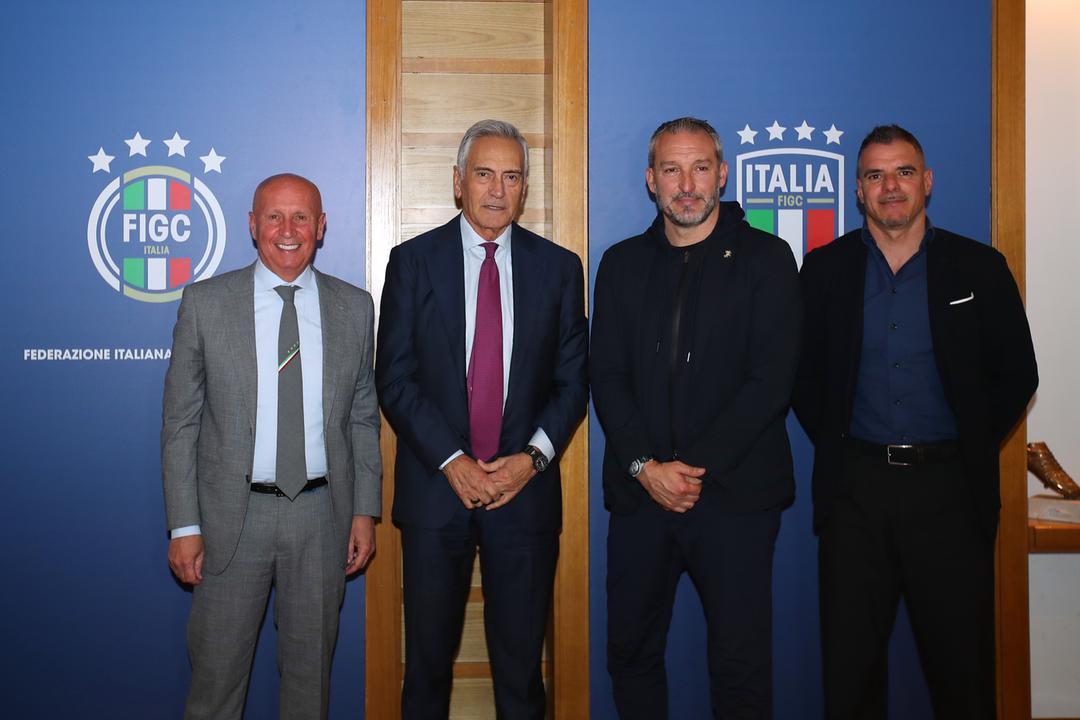
The Federazione Italiana Giuoco Calcio has launched a new “Technical project for Italian football” and has done so with a total effort to coordinate all of the bodies involved in development across the board: coaches, youth and school football, and the Italy national teams. While maintaining the autonomy of the three structures with their own mandates, FIGC president Gabriele Gravina, as outlined in his manifesto for February 2025, wanted to create a single coordinated system, bringing the Federation in line with other European Associations. He has entrusted the role of Technical Director to Maurizio Viscidi. An experienced professional with over ten years of coordinating Italy’s youth teams, from the start of the current season, he has been a keen promoter of the start of the Federation's U14 project, which is the link between amateur kids’ football and international representative teams from Under-15s. He will communicate with the project leads from all three sectors in order to best direct this relaunch of academies and finally respond to the growing question surrounding the generation of talent in Italian football.
“The project we’re presenting today concerns the heart of Italian football,” said Gravina, who will also have the precious support of Cesare Prandelli as an expert advisor. “It is born out of the necessity to give a boost to youth football. The reform comes as a result of a profound reflection, supported by an in-depth study into the international benchmarks. It brings our Federation closer in line with the rest of Europe, and is also thanks to the naming of Maurizio Viscidi as the Technical Director for the youth game. In my manifesto for the election, I outlined the issues, which are known to everyone, and proposed several solutions following discussions with the components of the footballing system and key experts in the field, whom I thank. On the basis of these meetings, we decided to carry out the project in order to kick off a kind of ‘new deal’ in creating value for the grassroots game in Italy, with the objective of creating a proper office for Italian talent. Our Federation, unlike other European Associations, has never had the figure of a Technical Director to coordinate the various bodies. That’s why we thought that this was the opportune moment to introduce such a position, while fully respecting the autonomy of the Technical Department, the relevant committees of the Youth and School Football Department, and the national teams. It wasn’t easy to find a common language framework for a technical profile, but it was a necessary step to build a shared vision. We want to have an ever more positive impact in getting kids to have fun and learn, so that we can cultivate talent thanks to an ambitious and structured programme.”
During the presentation of the project, Viscidi outlined the philosophy which will guide this new Federal development process: “I want to thank the President for handing me this new role. I think that the choice fell on me because I’m a practical man and I have deep knowledge of all the bodies involved in this project. I’m also in touch with youth football 24 hours a day. My task is to bring synergy to the technical areas of the FIGC, which have all backed youth football. I will touch base with the various technical components with the aim of bringing a shared idea. We want to focus on the technical side of things because we have noticed that, in Italy, there is maybe too much focus on tactics and results. As a Federation, we will try to ensure that technique is the core aspect of the development of young footballers. We’ll propose a training model to the clubs, and we will guide coaches and clubs in their daily work, because if we improve the individual, we improve the collective.”
Individual technique will be at the heart of the project, combined with consummate methodologies based on age and ability. So, there will be more play based on technique and less desperate searching for a result through tactics. It’s a widely shared concept, but the application thereof is not simple, due to the excessive culture of competitiveness in football.
Loyal to the concept of a “need to get on the ball more,” Viscidi will have the task of harmonising various programmes under a common objective: having an ‘Italy model’ in the development of young players. With the contribution of a team of experts and by making use of modern technology, it will be necessary to increase quality on the ball through a higher number of correct repetitions of the various drills, so that the skills can be best applied in a game. In order to do so, a simple and practical will be produced in order to render the work done throughout the country more uniform.
However, like every new construction, there is a need to start from the ground up. The foundations have to be solid and able to sustain the whole project, starting from the base of the Italian game. This programme was developed by world champions Simone Perrotta and Gianluca Zambrotta, who, specifically within Youth and School football, have updated the guidelines for the model as a whole. The core of the reform, in fact, is the training process for children aged 5 to 12, whose personal and sporting development must go hand in hand with the improvement of their technical and life skills.
Therefore, the kids themselves are at the heart of the programme, with an attention to detail that isn’t aimed at producing talent for talent’s sake, but rather at fostering an entirely new sporting culture. According to this approach, champions and talent are the result of a broader training model.
In this context, a direct contribution from the Italy legends has worked its way into the project. Simone Perotta explained the educational value of the initiative: “Gianluca (Zambrotta [EN]) and I are here at this table today, but this project has more founders than just us. The idea came from our experience and our discussions with Maurizio Viscidi, with whom we share the idea that technique has to return as the core in developing young footballers. I’m aware of the great work done by the Youth and School Sector, of which I am the Vice Chairman, but there was a need to implement what already existed. We want to invest in the education of coaches, for which we will organise free online courses (for UEFA C licenses [EN]). The Federation also needs to think about the kids who don’t go on to become footballers, providing them with the basics in ethics and morals, as well as footballing ability.”
Gianluca Zambrotta, Vice Chairman of the Technical Sector, agrees. “This is an important project for kids aged between five and twelve, so for foundational football. It will be a project shared by all the various components. Together with the Technical Sector, Coaching School and Youth & School Sector, we will try to bring a new wave of methodologies. It will be an ad hoc project, which will offer something important to creating the backbone of the future of youth football in Italy.”
The new grassroots development pathway, which will be implemented in close collaboration with the Technical Sector and the Coaching School at Coverciano, is built around the following key guidelines: increasing the number of courses for “Head of Grassroots Activity”; enhancing the qualification of instructors; introducing “category-based planning” through a dedicated training pathway; and reorganising and strengthening the Territorial Development Areas, with the role of the AST coach set to intensify collaboration with individual clubs.