

PHOTO
The lead-up to October 2026 continues apace, when the UEFA Executive Committee will decide on the ten venues that will host UEFA EURO 2032. Before that date, Italy and Turkey must each submit to the governing body of European football a shortlist of five cities that meet a range of requirements relating to hospitality, accessibility and infrastructure capacity, as well as the overall safety and sustainability of the event.
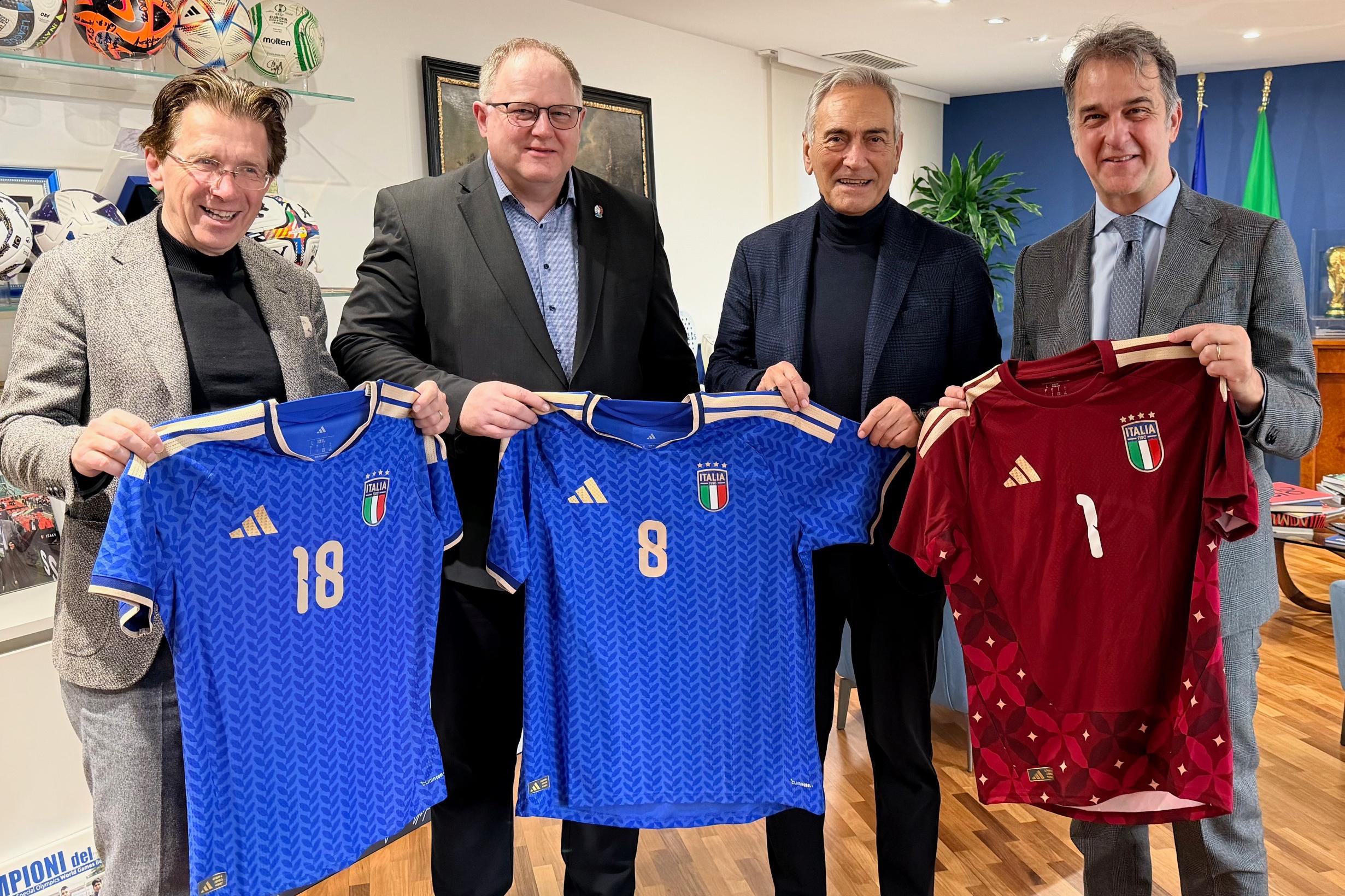
UEFA IN ITALY. Last week, a UEFA delegation made up of Martin Kallen, CEO of UEFA Events SA, Michele Uva, Executive Director and EURO 2032 delegate, and Andreas Schaer, Director of UEFA Events, visited Italy. At the headquarters of the Italian Football Federation in Rome, they met FIGC President Gabriele Gravina, along with the entire federal team overseeing the bid project, led by General Secretary Marco Brunelli. During the visit, the UEFA delegation was also able to review the progress of the nine venues currently aligned with the bid criteria. They carried out site visits at the Stadio Artemio Franchi in Florence, and at the Stadio Olimpico in Rome, with the support of Sport e Salute. At the federation’s Via Allegri headquarters, they also met representatives of the municipal administration and Cagliari Calcio regarding the project for the new stadium that will be named after Gigi Riva. The delegation subsequently held further discussions with AS Roma about plans for the construction of the club’s new stadium in Pietralata. Additional updates with the cities of Milan, Palermo, Salerno and Genoa are scheduled to take place during March. Working in close coordination with UEFA, the FIGC is continuing to collaborate with all the cities and clubs involved in the bid, with whom a detailed timetable of activities has been jointly established.
THE IMPACT OF A EUROPEAN CHAMPIONSHIP. The European Championship is the third-largest multi-day sporting event in the world (after the Summer Olympic Games and the FIFA World Cup), with a cumulative global television audience of 5.4 billion viewers. The most recent edition, held in Germany, generated more than €7.5 billion for the host cities and welcomed three million fans in stadiums, in addition to six million supporters who attended the various fan zones. Those fans came from 190 different countries, highlighting the truly global nature of the event.
GRAVINA. “I would like to thank UEFA for its availability and for the constructive discussions,” said Gabriele Gravina. “We are aware that Italy has started later than the rest of Europe when it comes to sports infrastructure, but the interest and the investments that have followed since the bid was awarded, together with the cooperation of the ministries involved and all the local authorities, give us reason for optimism. The FIGC is strongly committed to hosting this European Championship; we want to bring another major event to Italy to show the world the very best of our country.”