

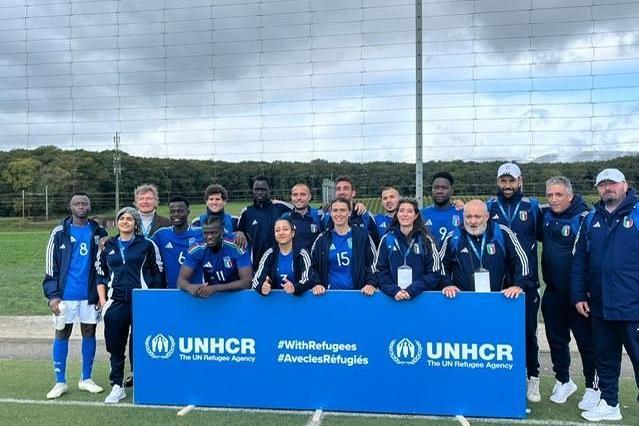
PHOTO
Through football, refugees can become an integral part of their host communities, sharing experiences, passions, and common values. On World Refugee Day, FIGC renews its commitment to promoting inclusion through football, reaffirming the value of sport as a tool to create opportunities, connections, participation, and interaction with people from different cultures and backgrounds.
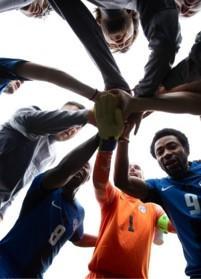
For many years, the Federation has marked this important occasion with activities aimed at raising awareness, providing sports opportunities and integration pathways for refugees and asylum seekers, while promoting a welcoming culture and respect for diversity. Through their experiences, stories, and journeys, refugees enrich football and local communities every day by bringing talent, diversity, new perspectives, and values.
In 2026, this commitment takes on even greater significance thanks to the organisation of the Road to Unity EURO Cup 2026 and the Unity EURO Cup 2026, which will be hosted in Italy for the first time at the Federal Technical Centre in Coverciano. World Refugee Day is not only a moment for reflection and awareness, but also the starting point of a journey leading up to October’s event.
This initiative aligns with Policy 6 (Support for Refugees) of FIGC’s Social and Environmental Sustainability Strategy, in line with UEFA’s sustainability framework, demonstrating FIGC’s determination to use football as a driver of social integration and the development of increasingly inclusive, welcoming, and united communities.
ROAD TO UNITY EURO CUP 2026
From 20 to 22 June, the Federal Technical Centre in Coverciano will host the Road to Unity EURO Cup 2026, an initiative made possible through funding received from UEFA under the UEFA Football and Refugee Grant Scheme 2025/26.
The event will bring together players from 13 different nationalities and various regions across Italy for a programme of football activities, training sessions, and shared experiences aimed at selecting the squad that will make up Refugee Team Italy, which will represent FIGC at the next edition of the Unity EURO Cup.
The selection event is a major milestone on the road to the fifth edition of the Unity EURO Cup, which will be hosted for the first time in Italy on 15 October 2026 in Coverciano.
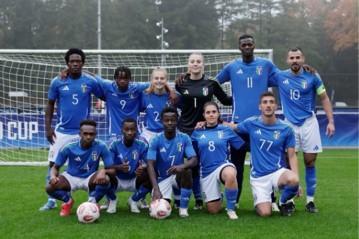
UNITY EURO CUP
The Unity EURO Cup is an annual football competition organised by UEFA in partnership with the UN Refugee Agency (UNHCR), with the goal of promoting social inclusion through football.
The tournament brings together teams consisting of refugees and representatives of local communities from participating countries, providing a practical example of sport as a tool for integration, intercultural dialogue, and social cohesion.
From its fourth edition in 2025, the competition became UEFA’s 24th official competition. The fifth edition of the Unity EURO Cup will be hosted by FIGC on 14–15 October 2026 at Coverciano.
FIGC has participated in the competition since its inaugural edition in 2022 in Nyon, Switzerland, where Italy finished third. Since then, the Federation has taken part in every edition (Nyon 2022, Frankfurt 2023, Nyon 2024 and Zeist 2025), further strengthening its commitment.
The 2025 edition, held in the Netherlands on 15 October at the Dutch FA’s training centre in Zeist, featured 18 teams, including Italy’s refugee team. The 2026 edition at Coverciano will feature 22 teams: Albania, Armenia, Austria, Belgium, Czech Republic, Finland, France, Germany, Greece, Italy, Latvia, Liechtenstein, Malta, Netherlands, Northern Ireland, Poland, Republic of Ireland, Romania, Slovenia, Spain, Switzerland, and an EU representative team, the highest number in the tournament’s history.
FIGC is looking forward to hosting the fifth edition in Italy, an event that has become a powerful symbol of the values of inclusion, participation and dialogue promoted by European football. The awarding of the Unity EURO Cup 2026 to FIGC is an important recognition of the Federation’s work over the years and further strengthens the role of Italian football in promoting more inclusive, welcoming and united communities.

RETE! REFUGEE TEAMS PROJECT
FIGC’s commitment to inclusion is also demonstrated by RETE! Refugee Teams, a project run by the Youth and School Sector and active since 2015 in collaboration with Italy’s national reception system. The project is aimed at young people living in SAI (Reception and Integration System) centres, reception facilities, residential communities, and foster homes across Italy, with the objective of promoting social and intercultural inclusion through football. Through sporting, educational and training activities coordinated by the Youth and School Sector’s regional network, RETE! encourages interaction among peers, promotes values such as respect and participation, and creates concrete opportunities for integration within local communities. Over ten editions since 2015, the project has involved 11,613 young people and 1,027 reception centres, helping make football a tool for personal growth, wellbeing and social inclusion.
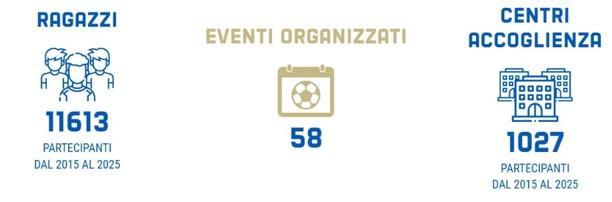
In 2026, the project involved 91 reception centres, 784 players and 29 sports clubs working in partnership with host facilities. These figures demonstrate the initiative’s strong roots across the country and provide the foundation for programmes such as the Road to Unity EURO Cup and the participation of Refugee Team Italy in the Unity EURO Cup, reflecting FIGC’s commitment to using football as a tool for inclusion, participation and intercultural dialogue.
UNHCR Campaign: Until Everyone Is Safe
To mark World Refugee Day, UNHCR has launched the campaign “Until Everyone Is Safe.” At a time when the right to seek asylum is under increasing pressure in many parts of the world, the campaign is built on a simple, powerful, and universal principle: the right to safety concerns all of us. “Until Everyone Is Safe” is aimed at younger generations, who are motivated by a desire for social justice and solidarity but are also facing uncertainty and socio-economic pressures. The campaign encourages them to view asylum not as a distant or abstract issue, but as a collective safety net that protects the most vulnerable today and could protect any one of us tomorrow.